North Carolina transportation connects mountains, metros, and coastline with surprising ease. This North Carolina Transportation guide covers how to reach the state, how to move between cities, and how to explore once you’re here.
We’ll walk through major airports like Charlotte Douglas International and Raleigh Durham International, Amtrak routes such as the Piedmont and Carolinian, key highways including I-40 and I-95, plus local transit systems that keep daily life moving.
Why does this matter? Because North Carolina is long and beautifully varied. You can land in Charlotte in the morning and watch the sunset on the Blue Ridge Parkway by evening.
You can drive I-40 from the Smokies to Wilmington’s beaches in a day. Transportation shapes that freedom.
Travel in 2026 feels smarter, too. Mobile ticketing on Amtrak, expanded routes at RDU, real time highway updates through NCDOT’s 511 system, and stronger regional bus links make planning simpler.
Honestly, getting around North Carolina is less guesswork now and more strategy. And that changes everything.
Airports in North Carolina Transportation
Air travel plays a central role in North Carolina Transportation. The state stretches from the Appalachian Mountains to the Atlantic coast, so flying often saves hours on the road.
Any complete North Carolina Transportation guide must begin with airports because they connect the state to global markets, military bases, tech hubs, and beach towns.
Major International Airports in North Carolina
These airports handle the bulk of passenger traffic and long-haul connections. They are the backbone of North Carolina Transportation.
Charlotte Douglas International Airport (CLT) – North Carolina’s Busiest Airport
Charlotte Douglas International Airport is one of the busiest airports in the United States by aircraft operations.
It serves as a major hub for American Airlines and offers nonstop flights to Europe, Latin America, Canada, and dozens of US cities.
Key facts:
- Located in Charlotte, near I-85 and I-77
- Serves over 50 million passengers annually
- Major hub for American Airlines
- Direct international routes to London, Frankfurt, Munich, Madrid, and more
CLT works like a central switchboard. Flights connect the Southeast to global destinations with minimal layovers.
For business travelers and international visitors, it anchors North Carolina Transportation at a national scale.
Raleigh-Durham International Airport (RDU) – Gateway to the Research Triangle
RDU sits between Raleigh and Durham, serving the Research Triangle Park region. It is one of the fastest-growing airports in the country, fueled by technology, biotech, and university traffic.
Key facts:
- Located near I-40
- Serves over 14 million passengers annually
- Airlines include Delta, American, Southwest, United, JetBlue, and international carriers
- Nonstop routes to London, Paris, Toronto, Cancun, and major US cities
RDU feels efficient and compact compared to CLT, yet it connects globally. For many travelers reading a North Carolina Transportation guide, this airport becomes the first stop when visiting Duke University, UNC Chapel Hill, or NC State.
Piedmont Triad International Airport (GSO) – Central North Carolina Hub
GSO serves Greensboro, Winston-Salem, and High Point. While smaller than CLT and RDU, it plays a critical regional role.
Key facts:
- Located near I-40 and I-73
- Airlines include American, Delta, United, and Allegiant
- Strong cargo presence, including FedEx operations
It offers easier parking and shorter security lines. For travelers who value convenience over volume, GSO is often a smart entry point within North Carolina Transportation.
Regional Airports Supporting North Carolina Transportation
Beyond the major hubs, regional airports strengthen connectivity across the state. They reduce travel time to mountain towns, military bases, and coastal communities.
Asheville Regional Airport (AVL) – Gateway to the Blue Ridge Mountains
- Located south of Asheville near I-26
- Fast-growing passenger numbers
- Airlines include Allegiant, American, Delta, United, and JetBlue
- Direct access to Blue Ridge Parkway andthe Great Smoky Mountains
AVL is popular during the fall foliage season. Flights increase when leaf colors peak. That seasonal rhythm matters for tourism planning.
Wilmington International Airport ILM
- Located near downtown Wilmington
- Airlines include American, Delta, United, and Avelo
- Convenient access to Wrightsville Beach and Carolina Beach
ILM supports coastal tourism and film production industries. For beach vacations, this airport cuts driving time significantly.
Other Important Regional Airports in North Carolina
North Carolina Transportation also includes:
- Fayetteville Regional Airport FAY serving Fort Liberty military community
- Concord Regional Airport, USA, serving low-cost carriers near Charlotte
- Coastal Carolina Regional Airport EWN in New Bern
- Pitt Greenville Airport PGV) serves eastern North Carolina
- Albert J Ellis Airport OAJ near Jacksonville
These airports may not handle international routes, but they provide vital regional links. They reduce highway congestion and support local economies.
Top NC Airports Codes And Features
Below is a quick reference table for travelers using this North Carolina Transportation guide.
| Airport | Code | Service Type | Highlights |
| Charlotte Douglas International | CLT | International Regional | Major hub with global connections |
| Raleigh Durham International | RDU | International | Rapid growth strong tech and university traffic |
| Piedmont Triad International | GSO | Regional | Serves the Greensboro Winston Salem area |
| Asheville Regional | AVL | Regional | Gateway to the Blue Ridge Mountains |
| Wilmington International | ILM | Regional | Direct access to the North Carolina coast |
This snapshot helps when planning routes or comparing options in a North Carolina travel guide by mail.
Airport Transportation Options in North Carolina
Getting from the airport to your final destination is part of North Carolina Transportation planning. Fortunately, options are clear and reliable.
Ride-Hailing Services (Uber & Lyft)
Available at CLT, RDU, GSO, AVL, ILM, and most regional airports:
- Uber
- Lyft
Taxi Services at North Carolina Airports
Common licensed airport taxi providers include:
- Crown Cab Charlotte at CLT
- Taxi Taxi of Charlotte
- RDU Taxi
- Greensboro Taxi
- Asheville Yellow Cab
- Wilmington Taxi
Airport Shuttle and Hotel Transportation
- SuperShuttle Express at CLT and RDU
- ExecuCar private car service
- Hotel courtesy shuttles at most major airports
- Groome Transportation serving AVL and regional routes
Public Transit Connections from Major Airports
Public transit strengthens airport access:
- GoTriangle Route 100 and Route 700 serving RDU
- Charlotte Area Transit System CATS Sprinter Route 5 Airport Connector at CLT
- PART Express regional buses serving GSO
- Asheville Rides Transit ART serving the AVL area
- Wave Transit serving ILM
These links connect airports to downtown cores, universities, and transit hubs. When mapped together, they show how structured and practical North Carolina Transportation has become.
Heading west by car or bus? Don’t miss our Cherokee in North Carolina: Ultimate 2026 Guide (Top 7 Tips) for route ideas, scenic drives, and insider travel advice.
Rail Transportation in North Carolina
Rail remains one of the most reliable pillars of North Carolina Transportation. It is not flashy, and it is not the fastest option every time. Yet it connects the state’s largest cities with a steady rhythm.
For many travelers reading a North Carolina Transportation guide, trains offer something highways cannot. Space. Predictability. Time to think.
Amtrak Train Routes Serving North Carolina
Amtrak operates several key routes that form the backbone of passenger rail within North Carolina Transportation.
These trains link major cities inside the state and connect North Carolina to the Northeast and the Deep South.
Primary Amtrak Routes Serving North Carolina
- Carolinian
- Route: Charlotte to New York City
- Major NC stops: Charlotte, Salisbury, High Point, Greensboro, Burlington, Durham, Cary, Raleigh, Rocky Mount
- Typical one-way fare within NC: 25 to 45 USD, depending on distance and demand
- Piedmont
- Route: Charlotte to Raleigh
- Multiple daily round-trip
- Major stops: Charlotte, Kannapolis, Salisbury, High Point, Greensboro, Burlington, Durham, Cary, Raleigh
- Typical fare: 20 to 35 USD
- Silver Meteor
- Route: New York to Miami
- NC stops: Rocky Mount, Wilson, Selma, Fayetteville
- Connects North Carolina with the Northeast and Florida
- Fare from Fayetteville to New York often starts around 70 to 120 USD
Key Stations In North Carolina
- Charlotte Gateway Station area is currently served by the Charlotte Amtrak Station on North Tryon Street
- Raleigh Union Station modern hub in downtown Raleigh
- Greensboro Station historic depot serving multiple routes
- Durham Station is centrally located near downtown
- Fayetteville Station serves the eastern corridor, travelers
These stations connect directly to local bus systems and downtown districts. Trains may not always beat flights on speed, but they win on simplicity.
Board, sit, arrive. No long security lines. No gate changes.
Local And Regional Rail Projects
Rail in North Carolina: Transportation is evolving. Service today focuses on intercity passenger rail, yet infrastructure upgrades continue across the state.
Current Rail Service Status
- Four daily Piedmont round-trip between Charlotte and Raleigh
- One daily Carolinian round-trip
- Long-distance Silver Meteor service
- State-owned rail corridor between Charlotte and Raleigh managed by NCDOT
Future Rail Proposals And Investments
- S Line Project
- Planned corridor between Raleigh and Richmond
- Will improve Northeast connectivity and reduce travel time to Washington DC
- Charlotte Gateway Station Development
- Multi-modal hub combining rail, bus, and future transit
- Southeast High Speed Rail Corridor
- Long-term plan linking Charlotte, Raleigh, Richmond, and Washington DC
Federal infrastructure funding in recent years has accelerated planning. Travel times may shrink over the next decade. Rail may not replace highways, but it will compete more strongly.
Tips for Traveling by Train in North Carolina
Train travel works best when planned smartly. Here is what matters.
Booking And Seat Classes
- Tickets available via the Amtrak website and the Amtrak mobile app
- Coach class is standard and comfortable
- Business class available on Piedmont and Carolinian with extra legroom
- Fares increase closer to the departure date
Luggage And Boarding
- Two free carry-on bags allowed
- Checked baggage is available at major stations such as Charlotte and Raleigh
- Arrive 20 to 30 minutes before departure
Connecting To Local Transit
Major stations connect to:
- CATS bus network in Charlotte
- GoRaleigh buses at Raleigh Union Station
- GoDurham buses at Durham Station
- Greensboro Transit Authority buses
- Fayetteville Area System of Transit buses
Rail may feel old-fashioned to some. Yet within North Carolina Transportation, it provides balance. Roads handle volume. Airports handle distance. Trains handle the space in between.
Public Transit and Mass Transportation in North Carolina
Mass transit keeps North Carolina Transportation practical at street level. Airports and rail lines move you between cities. Local buses and light rail move you through them.
That difference matters. Once you land in Charlotte or Raleigh, you still need a reliable way to reach hotels, campuses, offices, or stadiums.
Transit Systems By Metro Area
Each metro area manages transit according to its size and density. Some rely on light rail. Others depend entirely on bus networks.
Charlotte Area Transit System (CATS)
CATS is the largest transit operator in the state. It includes:
- LYNX Blue Line light rail running from I-485 South to UNC Charlotte
- City bus network serving Charlotte neighborhoods
- Sprinter Airport Route 5 connecting to CLT
- CATS Pass App for mobile ticketing
Basic fares:
- Local bus and light rail one-way fare is 2.20 USD
- Day pass 6.60 USD
The Blue Line has reshaped development along South Boulevard and Uptown. Rail here is not symbolic. It carries real commuter volume.
GoTriangle And Triangle Transit Systems
The Research Triangle relies on a coordinated bus network:
- GoTriangle regional buses
- GoRaleigh city buses
- GoDurham city buses
- GoCary town buses
Base fares:
- GoRaleigh and GoDurham typically charge 1.25 USD per ride
- GoTriangle regional fare ranges from 2.00 to 3.00 USD
Routes connect Raleigh Union Station, RDU Airport via Route 100, Durham Station, and major universities. Service frequency has improved along high-demand corridors.
PART Express Transit in the Piedmont Triad
Piedmont Authority for Regional Transportation operates PART Express buses between:
- Greensboro
- Winston Salem
- High Point
Typical fare:
- 2.40 to 3.00 USD depending on route
PART also links to Amtrak stations and park and ride lots. For regional commuting, it fills the gap between city bus and the private car.
Smaller City Transit Systems
Other cities operate fixed route buses:
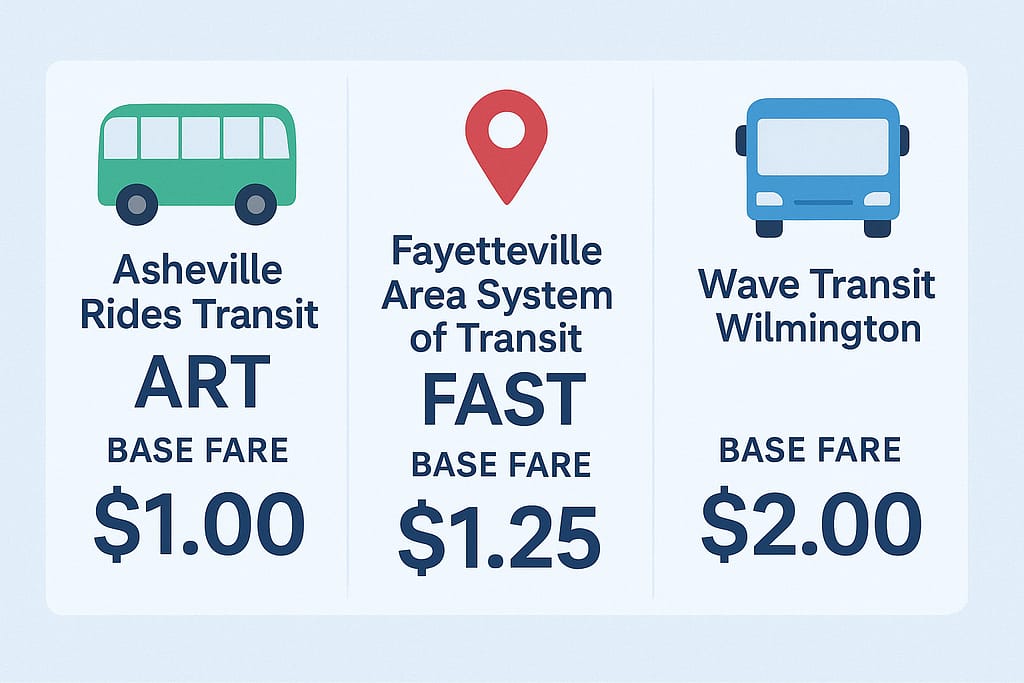
These systems focus on downtown loops, medical centers, and shopping corridors. They are smaller in scale, but essential within North Carolina Transportation.
Bus Networks And Intercity Bus Travel
Beyond city transit, intercity bus travel supports longer trips across the state and region.
Major Intercity Operators
- Greyhound serving Charlotte, Raleigh, Greensboro, Fayetteville, Wilmington
- Megabus serving Charlotte and Raleigh
- FlixBus expanding service in major corridors
- Sunway Charters operates select regional routes
Typical fares:
- Charlotte to Raleigh on Greyhound or Megabus can start around 25 to 40 USD, depending on demand
Planning Routes And Connections
Travelers can use:
- Greyhound and Megabus mobile apps
- PART regional maps
- GoTriangle system maps
- Google Maps transit planner
Bus travel may feel slower than driving. Yet it often costs less and avoids parking stress. Within North Carolina Transportation, buses are not an afterthought.
If your North Carolina transportation route takes you toward the mountains, check out 7 Stunning Glamping in North Carolina Spots for an Unforgettable 2026 Guide for unique stays near top transit corridors.
North Carolina Highways and Major Driving Routes
Highways are the backbone of North Carolina Transportation. Rail and air matter, yes. But roads carry the largest share of daily movement across the state.
From freight trucks on I-40 to beach traffic heading east in summer, highways shape how North Carolina lives and travels.
Key Interstate Highways in North Carolina Transportation
The interstate network forms the structural grid of North Carolina Transportation. These corridors connect cities, ports, airports, and neighboring states.
Interstate 40 – Cross-State East-West Corridor
- Runs east-west across the entire state
- Enters from Tennessee near the Great Smoky Mountains
- Passes Asheville, Hickory, Statesville, Winston Salem, Greensboro, Burlington, Durham, Raleigh
- Continues to Wilmington near the Atlantic coast
I-40 is the primary east-west corridor. It links mountain tourism, research universities, and coastal ports. Freight and commuter traffic both rely on it heavily.
Interstate 95 – Major East Coast Travel Route
- Runs north-south along eastern North Carolina
- Enters from Virginia near Roanoke Rapids
- Passes Rocky Mount, Wilson, Fayetteville
- Exits into South Carolina
I-95 serves as the East Coast backbone. Long-distance travelers heading between Florida and the Northeast pass through here daily. It also supports military traffic near Fort Liberty.
Interstate 77 – Charlotte Commuter Corridor
- Connects South Carolina to Virginia
- Passes directly through Charlotte
- Intersects with I-85 and I-485
I-77 handles major commuter flow in the Charlotte region. Congestion during peak hours is common, especially near Uptown and Lake Norman.
Other Key Interstates
- I-85 connecting Charlotte, Concord, Salisbury, Greensboro, Durham
- I-26 linking Asheville to South Carolina and Tennessee
- I 73 and I 74 improving regional connectivity in the Piedmont
- I 485 Charlotte outer loop
- I-540 and I-440 Raleigh beltlines
- I 795 eastern connector near Goldsboro
Together, these routes create the operational framework of North Carolina Transportation.
State Highways And Scenic Routes
Beyond interstates, state highways add depth and character. They connect rural counties, farmland, forests, and waterfront communities.
Key State Highways
- NC 45 connecting Plymouth and the coastal regions
- NC 87 running from the Virginia border to Southport
- US 64 major east-west route through Raleigh and the Outer Banks
- US 70 connecting coastal and central cities
- US 421 linking Wilmington to the western Piedmont
These roads often carry less traffic but more scenery.
Blue Ridge Parkway And Scenic Byways
- Blue Ridge Parkway runs 252 miles through western North Carolina
- No commercial traffic allowed
- Popular during the fall foliage season
Scenic byways such as the Cherohala Skyway and Outer Banks National Scenic Byway provide slower travel but a richer experience. Highways move you fast. Scenic routes let you notice where you are.
Driving Tips for Traveling in North Carolina
Driving conditions vary by region.
Road And Seasonal Conditions
- Mountain areas near Asheville may see winter snow and fog
- Coastal regions face hurricane season impacts from June to November
- Urban corridors like I -77 and I-40 experience peak congestion during weekday rush hours
Safety And Real Time Travel Info
- Call 511 for statewide traffic updates
- NCDOT 511 website provides live maps and incident reports
- NC Quick Pass electronic tolling applies on I 77 Express Lanes
North Carolina Transportation by road is efficient but not uniform. Mountains demand caution. Cities demand patience.
The coast demands weather awareness. Plan ahead, check 511, and the highways will serve you well.
Ferry Transportation and Coastal Travel in North Carolina
North Carolina Transportation isn’t just about roads, rails, and airports. You know what? The coast introduces a completely different rhythm.
Ferries and water transport are not only practical, but they are also almost scenic adventures in themselves.
Especially if you’re exploring the Outer Banks or island communities, riding a ferry is as much about the journey as the destination.
NCDOT Ferry System Overview
The NCDOT runs multiple ferry routes along the coast. These ferries are car and passenger-friendly, ensuring continuity of travel across islands and peninsulas. Key services include:
- Bayview-Aurora Ferry connects the Pamlico River communities
- Hatteras-Ocracoke Ferry linking Hatteras Island to Ocracoke Island
- Southport-Fort Fisher Ferry connecting the mainland to the Oak Island and Fort Fisher areas
- Cherry Branch-Minnesott Beach Ferry serving the Pamlico Sound
Each ferry accommodates cars, bikes, and walk-on passengers. Schedules vary seasonally, with summer months seeing more frequent trips due to tourism.
Ideal For Outer Banks Exploration
Ferries open doors to experiences you cannot reach by road alone. For example:
- Drive or bike across Hatteras Island, then take the Hatteras-Ocracoke Ferry to explore Ocracoke’s historic village
- Access quiet beaches and lighthouses unreachable by car alone
- Enjoy fresh air and coastal views while traveling. Some travelers even consider it the highlight of their North Carolina Transportation journey
Travelers can plan around seasonal tides and ferry schedules. Ticketing is straightforward, usually cash or card on board, and reservations are recommended during peak summer weeks.
The ferry ride isn’t just transit; it’s an introduction to the state’s maritime heritage and a subtle reminder that North Carolina Transportation isn’t limited to land.
Elk Hollow Resort — Your Base For Exploring NC
If you’re mapping out your North Carolina Transportation journey, you need a home base that blends convenience with adventure. That’s where Elk Hollow Resort in Bryson City comes in.
Nestled amid the Great Smoky Mountains, it’s not just a place to crash; it’s a launchpad for exploring the state’s natural wonders and charming small towns.
You know what makes it extra special? You can wake up to crisp mountain air, sip coffee on a private deck, and still be within easy reach of major highways and local attractions.
Proximity To Highways, Parks, And Transit
Elk Hollow Resort sits just minutes from U.S. 19 and U.S. 74, giving road-trippers seamless access to Asheville, Cherokee, and other North Carolina destinations.
For those relying on the North Carolina Transportation guide tips, it’s close enough to regional transit hubs to make day trips stress-free.
Want to explore the Great Smoky Mountains National Park or hit the Tuckaseegee River for tubing and fishing? You’re practically there.
Amenities And Travel Tips

Elk Hollow Resort offers a range of accommodations:
- South African Safari Tents with climate control, private hot tubs, and decks with grills
- Luxury Hard-Wall Yurts with king beds and full kitchens
- Large Cabin Lodges are perfect for groups, featuring multiple bedrooms, full kitchens, and sunset-view patios
The resort’s romantic string lights, fire pits, and serene surroundings make it ideal for nature lovers, couples, and families alike.
Best seasons to visit? Spring and fall offer brilliant foliage, while summer provides river adventures. Don’t forget to pack layers; mountain evenings get chilly even in summer.
Traveling by highway or regional transit? Add adrenaline to your itinerary with our Best Zipline Adventures in North Carolina | Thrilling 2025 Guide.
Wrapping Up Your North Carolina Journey
Navigating North Carolina Transportation in 2026 offers plenty of choices: bustling airports, scenic rail lines, robust bus networks, and reliable local transit.
From Charlotte to Bryson City, there’s a way to move that fits every style and pace. You know what makes planning easier?
Downloading a North Carolina travel guide by mail or digitally, mapping your routes, and keeping transit apps handy.
Explore highways, railways, and trails responsibly, respect local rules, communities, and nature.
Whether it’s a road trip to the mountains or a rail adventure along the coast, your journey through the Tar Heel State can be smooth, memorable, and absolutely magical.
FAQs | North Carolina Transportation Guide 2026 | Top Ways to Travel
1. How do people get around in North Carolina?
People travel using a mix of cars, buses, light rail, Amtrak trains, and ride-hail services. Road trips are especially popular for exploring scenic areas like the mountains and coast.
2. Is there public transportation in North Carolina?
Yes, most cities like Charlotte, Raleigh, and Greensboro have bus networks and light rail systems. Regional services like GoTriangle and PART Express connect neighboring towns.
3. What is the #1 tourist attraction in North Carolina?
The Great Smoky Mountains National Park is the most visited destination. It offers hiking, rivers, wildlife, and year-round scenic beauty.
4. What are the biggest risks of living in North Carolina?
Weather events like hurricanes and occasional flooding are the main risks. Urban areas may also experience traffic congestion and higher commuting times.
5. How walkable is NC state?
Walkability varies by city. Downtown Charlotte, Raleigh, and Asheville offer pedestrian-friendly areas, but most suburban and rural areas rely on cars.
6. Is there a metro in North Carolina?
Charlotte has the LYNX Blue Line light rail system. Other cities primarily rely on buses and regional transit instead of traditional metro rail.
7. Can you Uber in North Carolina?
Yes, Uber and Lyft operate in all major cities and popular tourist towns. Ride-hail is convenient for short trips and airport transfers.
8. Can I pay card or cash on a bus?
Most city buses accept both cash and contactless card payments. Mobile apps like CATS Pass, GoRaleigh, and GoDurham make card payments even easier.
9. Is the light rail in Charlotte free?
No, Charlotte’s LYNX Blue Line requires a ticket or pass. Single rides cost around $2.20, with day passes and monthly passes available.
10. Which is cheaper, a local taxi or Uber?
Uber and Lyft are generally cheaper than traditional taxis, especially for short trips. Taxis can be more convenient in areas with limited ride-hail coverage.